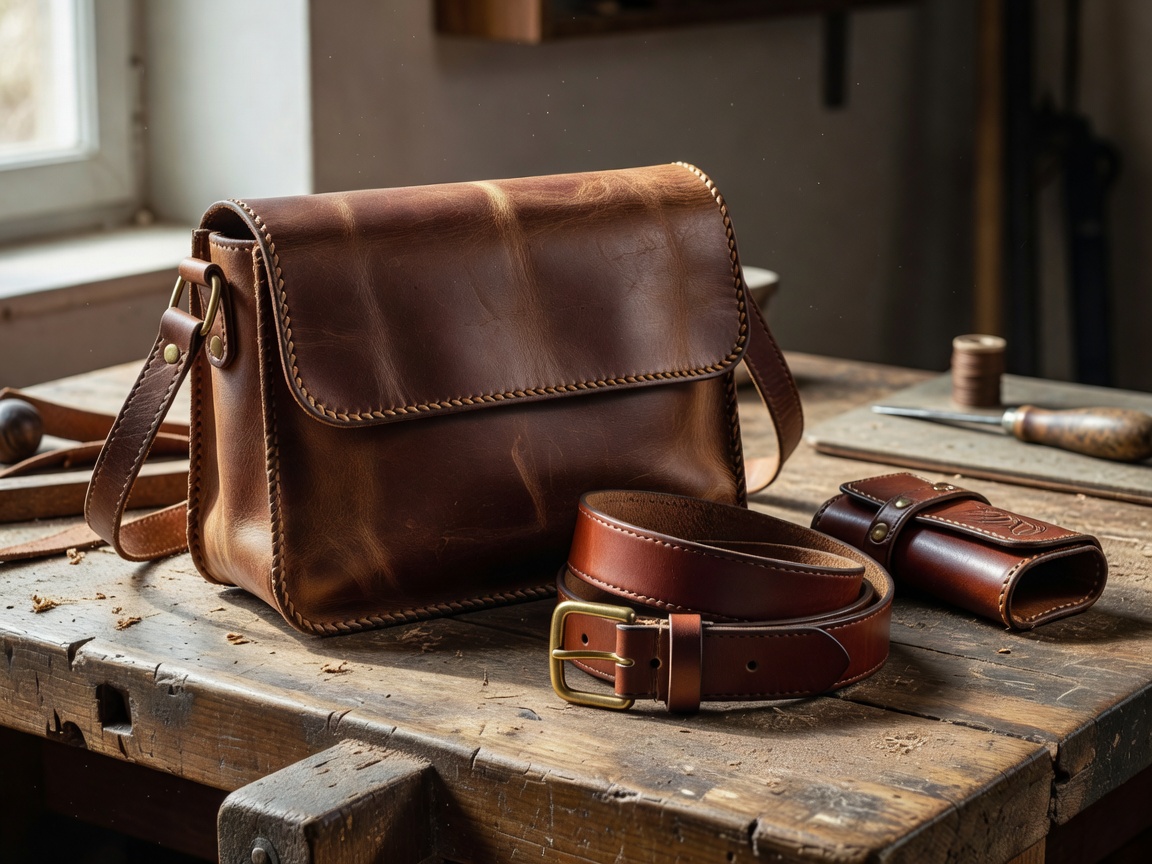
A handmade object is a set of decisions. The maker chooses leather, thickness, reinforcement, joining method, hardware and surface treatment. A wallet, belt, bag, notebook cover or travel case can be simple in appearance but demanding in tolerance. Examine how parts meet and how the object is expected to move.
Small goods
Wallets and card holders depend on accurate cutting, thin folded edges and controlled stitch spacing. A notebook cover needs a suitable balance between flexibility and structure. Small cases may use gussets, folded seams or a lining. Ask whether the edge is raw, burnished, painted or folded. Each option changes appearance and maintenance.
Belts and bags
A belt usually requires consistent strap width, a suitable thickness and hardware that matches the hole size and load. A bag introduces handles, panels, gussets, linings and closure systems. Reinforcement can sit behind handle attachments or beneath a base. Look for how stress is distributed rather than relying on surface decoration.
Hardware and stitching
Hardware includes buckles, snaps, rings, clasps and rivets. Finish, scale and placement affect both function and visual balance. Stitching can be structural or decorative. Examine thread tension, corner transitions and whether stitch holes align across layers. Adhesive may be used with stitching; its presence does not automatically indicate weak construction.
Material selection
Soft leather may suit a slouching bag but need support at handles. Firm leather may hold a wallet shape but require careful folding or skiving. Surface finish affects marks and cleaning. Lining, edge paint and reinforcement should be considered as part of the object, not as afterthoughts.
Good for
- Writing a useful brief for a class or maker.
- Comparing construction without reducing craft to branding.
- Choosing an object whose maintenance fits its use.
What to know
- Visible variation can result from hand work, material character or tolerance.
- Ask what repairs or care are practical.
- Do not infer origin, certification or durability from appearance alone.
The strongest detail is usually the one carrying a load, guiding a fold or controlling an edge.