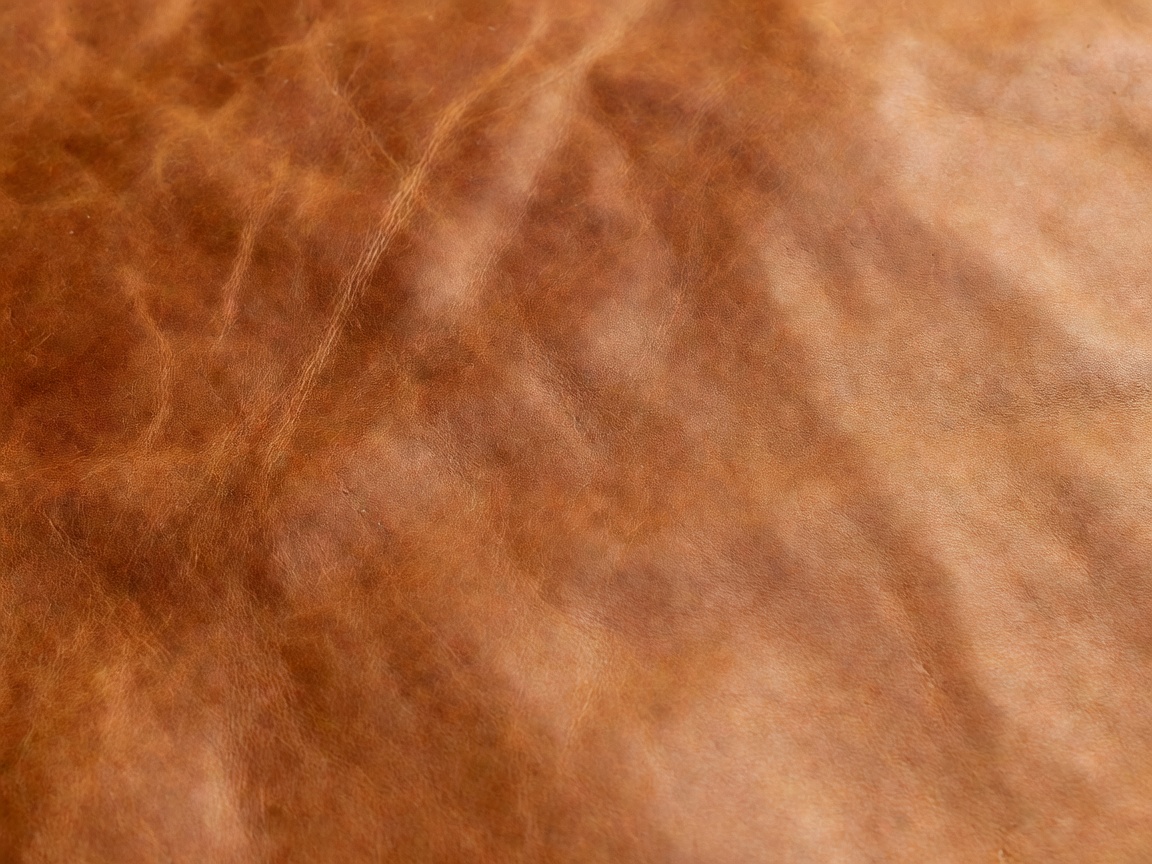
Leather is an animal hide that has been preserved through tanning and then finished for use. The result varies with animal, cut, tannage, thickness, dye, coating and surface treatment. Terms are useful only when paired with a specification. Ask for measurements and finish details.
Tannage and grain
Vegetable-tanned leather uses tannins and is often selected for moulding, tooling or a surface that changes with handling. Colour and response vary by tannery and finish. Chrome-tanned leather uses chromium salts in the tanning process and can be produced in many soft, flexible and colour-consistent forms. These labels describe a process; they do not automatically prove performance, origin or environmental impact.
Full-grain leather retains the outer grain surface, including natural markings. Corrected-grain leather has been mechanically or otherwise treated to alter the surface, often to create a more uniform appearance. Nubuck is leather sanded on the grain side to create a short nap. Suede is generally made from the flesh side or split layer and has a softer, fibrous surface. Definitions and commercial usage can vary, so request a sample.
Thickness and finish
Thickness is usually stated in millimetres or ounces. A thin lining leather behaves differently from a heavy strap leather. Weight, temper and stretch matter alongside the number. Finish may be an aniline dye, pigment coating, wax, oil, print, embossing or a combination. An aniline surface shows more natural variation; a coated surface may offer a more uniform appearance. Neither description is a complete durability claim.
Dyeing, conditioning and patina
Dye changes colour within the fibre, while pigment sits more visibly on the surface. Conditioning products add oils or waxes, but excess product can darken, soften or mark leather. Test on an inconspicuous offcut. Patina means visible change through handling, light, abrasion and time. Its direction depends on finish, use and care. It is not guaranteed to develop in a particular way.
Good for
- Matching a hide to folding, structure, tooling or lining.
- Comparing samples before a workshop or commission.
- Writing a precise material request.
What to know
- Ask for thickness, temper, finish and usable size.
- Natural marks are not automatically defects.
- Care instructions should come from the maker or supplier.
Material names are starting points. Sample the actual leather before committing.